
Theodynamics - Law Six
Updated: Apr 11
Law Six: The Law of Letting Go (The Power of Asymmetrical Kenosis)
April 12, 2026
The Power of the Towel
If you want to understand what a culture truly values, look at what it defines as power.
In our world, power is almost universally understood as an upward trajectory. From the time we are young, we are handed a script that says the world is a place of scarcity and danger. Because there is supposedly a limited amount of security, respect, and wealth to go around, the only way to be truly safe is to climb "the ladder of success." We are taught to accumulate influence, perfect our public image, and gather enough leverage so that no one can hurt us or tell us what to do. Power, in the human system, means building a throne high enough to lift you above the fray.
Psychology tells us that this relentless drive comes directly from the human ego. The ego is not inherently evil; it is the anxious, protective part of our soul that was formed to help us survive. But the ego operates on a profound delusion. It genuinely believes that if it can just control all the variables, win every argument, and manage every perception, it will finally be at peace.
Think about how exhausting this is. Think about the massive amount of life energy it takes to constantly defend your image, assert your dominance, and manipulate situations so you come out on top. And yet, the great irony of the ego is that the more coercive power we accumulate, the more isolated and anxious we become. Like a dying star that accumulates too much mass and collapses into a black hole, a life that constantly grasps for control eventually collapses in on itself.
This brings us to a threshold in our understanding of how the universe actually works. If the Divine Source is the ultimate power of reality, does God operate like an infinitely scaled-up human ego? Does God rule by coercion, force, and domination?
Theodynamics introduces a reality that flips our understanding of the universe completely upside down. We call it Law Six: The Law of Asymmetrical Kenosis, or simply:
The Law of Letting Go.
The Asymmetry of Divine Power
Kenosis is an ancient Greek word that means "self-emptying." Law Six states that the ultimate power in the universe does not operate through coercive force or domination. Instead, the characteristic movement of Divine power is downward-moving, self-giving love. Spirit intentionally steps down into the low, hidden, humble places rather than climbing up into visibility, comfort, and dominance. It moves from being served to serving – shifting from “What can I get?” to “How can I give?”
It is "asymmetrical" because it runs in the exact opposite direction of how human systems operate. The world says power is found in grasping; the Divine reality says power is found in letting go. "Downward-moving" is a spatial metaphor used to contrast the direction of divine power with the way human beings typically pursue and exercise power.
In human systems, power is almost always understood as an upward trajectory. To become powerful, a person must climb: we ascend the corporate ladder, accumulate wealth, raise our social status, and achieve a position where we can dictate terms to others. Divine power operates in the exact opposite direction. Instead of grasping for higher status, the ultimate power of the universe intentionally steps down.
Jesus gathers them around and completely redefines the physics of greatness:
“You know that those who are regarded as rulers of the Gentiles lord it over them, and their high officials exercise authority over them. Not so with you. Instead, whoever wants to become great among you must be your servant... For even the Son of Man did not come to be served, but to serve, and to give his life as a ransom for many.” (Mark 10:42-45)
Later, the Apostle Paul captures this beautiful reality in his letter to the Philippians, in our opening passage, which theologians call the "Hymn of Kenosis." He writes that Christ did not consider equality with God something to be used to his own advantage. Instead, he emptied himself. This is not just a nice moral lesson about the value of humility. This is a revelation of spiritual physics. It is pulling back the curtain on how the universe actually works.
The Power of the Towel
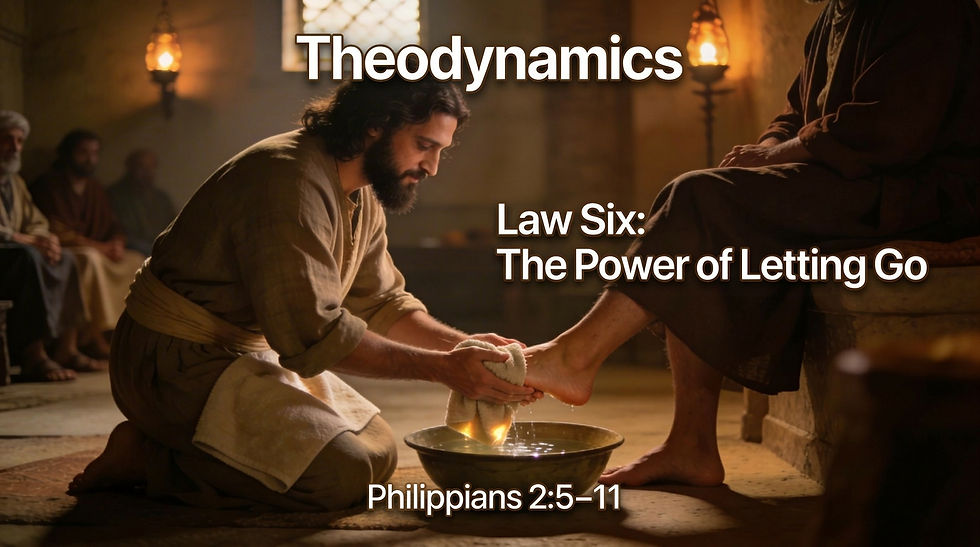
Imagine the scene in the upper room on the night before Jesus is to be executed. He is sitting with his friends, and the tension in the room is suffocating. What does the one who holds the wisdom of the cosmos do? He doesn’t assert his dominance. He doesn’t demand their allegiance.
The Gospel of John tells us that Jesus takes off his outer garments, wraps a towel around his waist, pours water into a basin, and kneels on the dirt floor to wash his friends’ feet (John 13:4-5).
He takes the posture of the lowest servant in the house. In doing so, he is saying, This is what the Divine is like. God is the one who washes feet. God sustains the universe not from the top down, through dictatorship and barking orders, but from the bottom up, through absolute, unconditional service.
Real power looks like a towel in your hand, not a crown on your head.
True divine power does not dominate from above; it serves and supports from beneath.
This translates to a profound psychological and spiritual truth: spiritual maturity is not about achieving a "higher" plane of religious superiority or accumulating spiritual leverage. It is about the downward mobility of the ego. We align with God not by climbing, but by lowering our defenses, releasing our need to be in charge, and finding our true strength in humble, self-giving service.
We see this most vividly and beautifully in the historical accounts of Jesus. His closest followers were deeply conditioned by the world’s operating system. They wanted a Messiah who would use divine force to crush their political enemies, establish a literal throne, and hand them positions of high status. They were looking for a CEO-King. In the Gospel of Mark, his closest friends are literally arguing with each other about who gets the highest-ranking seats when Jesus finally takes power.
For those of us seeking to live in alignment with the Divine, Law Six provides a deeply practical blueprint.
When we try to force outcomes, when we manipulate the people we love, when we fiercely defend our egos, we actually block the flow of grace within us. We become spiritually brittle. The ego takes up the entire room, leaving no space for the Divine to move. But when we practice kenosis, when we deliberately choose to let go of the need to be right, the need to be recognized, and the need to be in charge, we create a spaciousness within our souls. We create a vacuum, and the moment we create that empty space, the living, loving presence of God rushes in to fill it.
The Apostle Paul discovered this when he was wrestling with his own limitations. He begged God to remove a weakness from his life, but he heard the Divine voice respond: “My grace is sufficient for you, for my power is made perfect in weakness” (2 Corinthians 12:9).
We are not transformed by acquiring advanced spiritual techniques, and we do not change the world by winning arguments. We are transformed as we consent to be reshaped by downward-moving love.
Practicing Downward Mobility
Stepping out of the exhaustion of throne-building and learning to pick up the towel requires intentional practice. It requires starving the ego so the soul can breathe. Here are three ways to experiment with the Law of Letting Go:
1. The Leadership Inquiry
We all carry some amount of influence on others. So, whether we are a manager, a parent, a community volunteer, or a teacher, take a few moments of silence each day. Ask the Divine Spirit: “Where am I grasping for control right now, instead of pouring out in service?” Notice where our ego feels tight and defensive. Becoming aware of where we are trying to build a throne instead of holding a towel is the first step toward freedom.
2. The Act of Anonymous Service
Regularly choose one "low" task that benefits someone else but offers us absolutely no status, praise, or financial reward. Take out a neighbor’s trash, clean a shared space, or do a chore someone else hates doing. The absolute rule is that we cannot tell anyone we did it, and it cannot be traced back to us. The ego feeds on recognition. When we serve in complete secrecy, we align perfectly with the hidden, sustaining love of God.
3. The Breath of Release
When we feel ourself getting defensive, when someone criticizes us or disagrees with us, and we feel that familiar hot rise of the ego wanting to fight back ... pause. Take one deep breath in, and as we exhale, silently say the word, “Release.” Empty ourself of the need to win that moment. We can trust that our value is already infinitely secure in the Divine; we do not need to fight to prove our worth.
We live in a world that is exhausted by power struggles. We see it in our global politics, in our workplaces, and within our own homes. The invitation of Theodynamics is to step down from the tiring pedestal of the ego and discover the profound, liberating joy from letting go of status and control and pouring ourselves out in humble love.
It is my prayer that we align with God not by climbing, but by lowering our defenses and finding true strength in humble service. It is my prayer that God opens our heart to the truth that real power is found in the towel, the power of letting go ... of the small self, the ego, the need to control. When we have the courage to empty ourselves, we make room for a love that can heal the world.


Comments