
The Virtue of Hospitality
June 28, 2026
Scripture: Romans 12:13; Hebrews 13:2; 1 Peter 4:8–9; Luke 14:12–14
Hospitality is one of the ways God’s love moves in the world. If mercy is love’s response when something has gone wrong, and reconciliation is love that closes the distance, then hospitality is love that makes room. It is the open-hearted, open-handed movement of divine love that welcomes, receives, and creates space for the other.
Hospitality can be misunderstood as little more than entertaining well. Webster’s 1828 dictionary defines it as “the act or practice of receiving and entertaining strangers or guests without reward, or with kind and generous liberality.” That older definition reaches deeper than polished hosting. It is more than a well-set table, a tidy home, or polished social skills. It points to generosity, welcome, and the willingness to make room for another person without calculating what will be gained in return. At its deepest, hospitality is the spiritual practice of making room in our lives for others to experience dignity, safety, and belonging. In the language of this virtues series, hospitality is God’s love refracted as welcome.
The New Testament treats hospitality as a real mark of mature spiritual life; it is not peripheral. In Romans 12:13,Paul urges us to, “Contribute to the needs of the saints; pursue hospitality.” The language is active, not passive; hospitality is something to seek out and practice intentionally, not just something we offer when it is convenient. 1Peter 4:9 says, “Offer hospitality to one another without grumbling,” and Hebrews 13:2 adds, “Do not neglect to show hospitality to strangers.” So hospitality is not decorative. It belongs to discipleship.
For the Christian part of our community, that makes immediate sense. Jesus continually welcomed those others pushed aside: the outsider, the sinner, the weary, the person whose presence made respectable religion uncomfortable. He sat at tables with the overlooked, received people with dignity, and embodied the generous welcome of God. Hospitality is recognizing the sacred worth or divine image in every person and responding to that worth with reverence. It is the cooperation with a moral pattern built into life itself: communities flourish where welcome, generosity, and human dignity are practiced rather than withheld.
At the center of biblical hospitality stands a profound truth: God is the great Host. Scripture again and again portrays God as the One who makes room, spreads the table, provides what is needed, and welcomes the stranger. Even creation itself can be seen as hospitality: life is given, breath is shared, food is provided, and existence is opened to us as gift. The psalms, the prophets, and the teaching of Jesus all echo this sense that life with God is not cramped, suspicious, or grudging, but spacious, generous, and invitational.
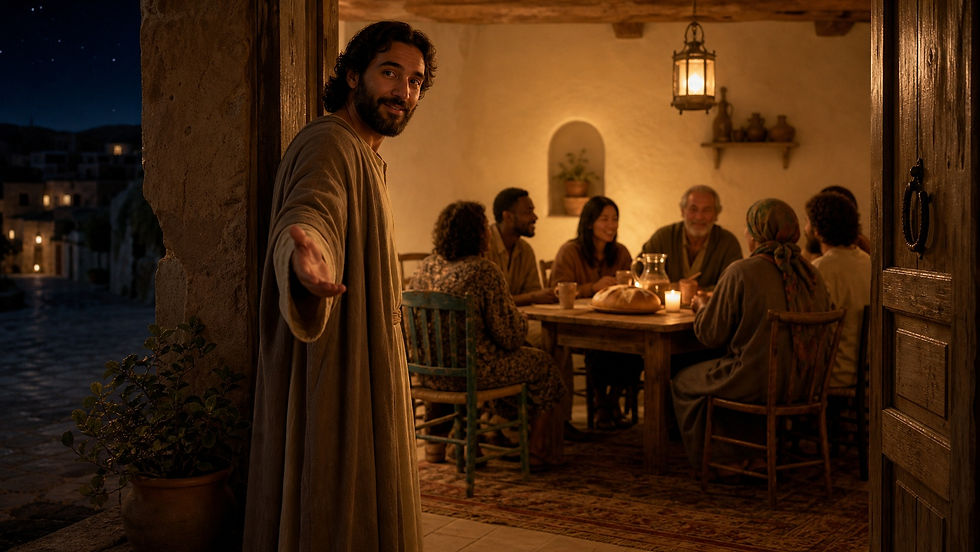
Jesus embodies that hospitality in especially vivid ways. He is both guest and host. He receives hospitality from others, entering homes and sharing ordinary meals, but he also becomes the host of grace, feeding crowds, breaking bread, and inviting people into the larger household of God. In Luke 14, he presses the matter further: “When you give a banquet, invite the poor, the crippled, the lame, and the blind.” That is a radical word, because it takes hospitality beyond comfort and reciprocity. It asks us to welcome those who cannot repay us, increase our status, or fit neatly into our usual circles.
That point matters, because much of what passes for hospitality in ordinary life is really selective comfort. We make room for the familiar, the agreeable, the useful, the socially easy. Biblical hospitality stretches us beyond that. It asks whether our love has room for the stranger, the outsider, the inconvenient person, the awkward guest, the one who carries need or difference with them. In that sense, hospitality is not just friendliness. It is generosity with spiritual depth.
This is why hospitality belongs so naturally in the relational virtue arc. Mercy responds when there has been harm. Reconciliation begins to close the distance that harm created. Hospitality then asks: once love has turned toward the other, how do we actually make room for them? How do we become people in whose presence others can breathe a little easier, soften a little more, and sense that they are not merely tolerated but genuinely welcomed?
Hospitality is not limited to the home, though the home is certainly one holy place where it can be practiced. A person can host a beautiful dinner and still be inhospitable in spirit. Another can offer a cup of coffee, a folding chair, and a warm attention that carries more grace than a formal banquet ever could. Hospitality can happen at a kitchen table, in a church foyer, in a hospital room, on the phone, through a note, in the tone of an email, or in the quality of one’s listening. At heart, hospitality is not first about presentation. It is about presence.
There is also an inward side to this virtue. Some of us can welcome strangers more easily than we can welcome difficult relatives, people with different views, or even parts of our own wounded story. Yet hospitality is not only about opening an outer door. It is also about the widening of the inner room. Can we let God enlarge the heart? Can we become less defensive, less hurried, less controlling? Can we make room for another person’s story without needing to dominate or manage it? That kind of inward hospitality may be one of the most needed forms of welcome in our time.
In that sense, hospitality connects to other virtues you have already explored. It grows out of courtesy, but goes deeper than politeness. Courtesy may express respect; hospitality expresses shared life. It links with reaching out, because hospitality is often welcome in motion: visiting the sick, inviting the lonely, including the newcomer, carrying burdens, and refusing to leave people stranded at the edge of the room. It resonates with humility, because only a humble heart can truly make room for another without needing to be the center of everything.
There is wisdom needed here too. Hospitality does not mean saying yes to every demand or erasing all boundaries. Love makes room, but love is also wise about how that room is made. Even Jesus did not entrust himself to everyone in the same way. So hospitality is not naive openness. It is discerning openness. It knows how to welcome without enabling harm, how to include without abandoning prudence, how to be generous without becoming unsafe.
For a church, hospitality may be one of the most revealing signs of spiritual health. A congregation may preach grace and still feel emotionally closed. It may have strong beliefs and yet leave people feeling invisible. Hospitality asks searching questions: Do newcomers feel received? Do lonely people find a place? Do those who differ from us sense they are still treated with dignity? Do we make room only for people like ourselves, or are we willing to be stretched by the wider welcome of God?
In many churches, the most powerful act of hospitality is not a formal ministry but a simple, human gesture: remembering a name, noticing the person standing alone, asking a sincere question, making room in a conversation, saving a seat, writing a note, or sharing a meal.
Hebrews adds a beautiful mystery to the subject: “Do not neglect to show hospitality to strangers, for by doing that some have entertained angels without knowing it.” Whatever else that means, it reminds us that the stranger is never just a category. We do not fully know who stands before us. The overlooked person may carry grace. The inconvenient interruption may become holy ground. Hospitality teaches reverence in the presence of the other.
And perhaps that is one of the deepest truths of all: in practicing hospitality, we begin to mirror the very life of God. In a light touch, this is one of the ways Theodynamics can be quietly heard here: God’s love is not self-enclosed. It moves outward. It creates space for life, relation, and communion. When we make room for another, we participate in that same divine movement.
So how do we grow in this virtue? Three questions may help.
First: Who is outside my usual circle? Who is easy for me to overlook—the newcomer, the shy person, the grieving person, the awkward person, the one who cannot repay me, the one who does not fit my assumptions? Hospitality begins when we notice who has not yet been made room for.
Second: What kind of room do I create around me? When people are with me, do they feel judged, hurried, managed, or welcomed? Do they sense that I am present to them? Hospitality may begin with something as simple as slowing down, listening more fully, and letting another person speak without interruption.
Third: What concrete act of welcome might God be asking of me this week? It may be opening your home. It may be inviting someone to lunch. It may be including someone in conversation. It may be making your church presence warmer, your tone gentler, your schedule a little less guarded, your heart a little more spacious. Hospitality grows through practice. One small act of welcome can become a doorway through which grace enters someone else’s life.
It is my prayer that we will become people who reflect the generous welcome of God. It is my prayer that our homes, our churches, our conversations, and our hearts will become places where others experience dignity, safety, and belonging. And it is my prayer that, as we make room for one another, we will discover again how much room God has already made for us.


soi cau mb mình thấy dễ thở hơn mấy trang mình từng lướt trước đó, kiểu không bị choáng vì chữ nghĩa dày đặc mà vẫn có điểm để bám theo. Mình vào chủ yếu xem họ trình bày thế nào thôi, và công nhận các tiêu đề được đặt rõ nên kéo xuống là biết đang ở phần nào (đỡ phải đoán). Có đoạn nói về Soi Cầu XSMB theo hướng thống kê, phân tích kết quả quay trước nên đọc lướt cũng hiểu họ đang dựa trên dữ liệu cũ để gợi ý. Mình cũng thích cách họ tách mấy ý như “chạm đầu đuôi” hay “bạch thủ” thành từng khối nhỏ, nhìn một cái là bắt nhịp…