
Mother's Day 2026
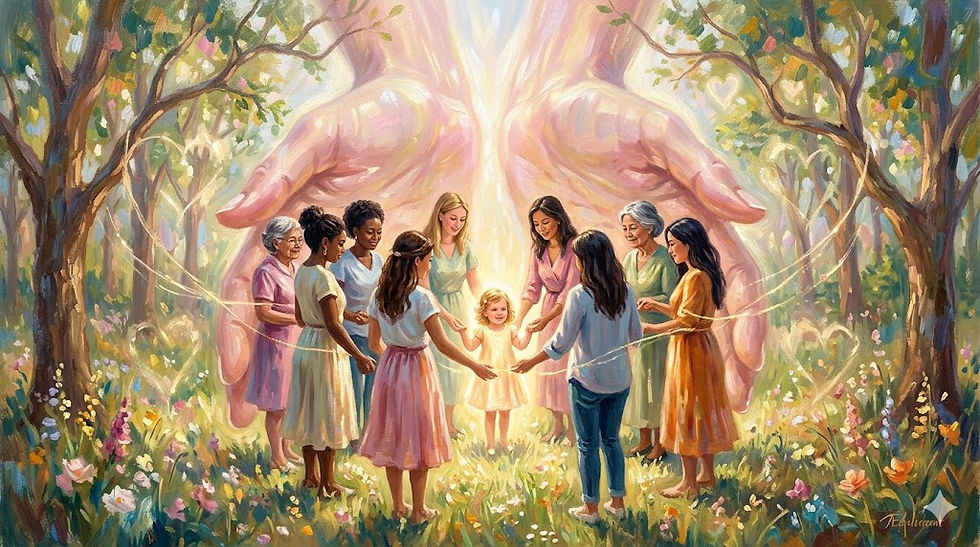
Mothering in an Age of Survival
5/10/2026
Proverbs 31:25–28
“She is clothed with strength and dignity, and she laughs without fear of the future. When she speaks, her words are wise, and she gives instructions with kindness. She carefully watches everything in her household and suffers nothing from laziness. Her children stand and bless her. Her husband praises her.”
Today is Mother’s Day — a day to celebrate and honor our earthly mothers for bringing us into this world, loving us, sharing their hearts with us, nurturing us, inspiring us, and then sending us on our way to establish our own lives.
Whether by birth or other means, we give thanks for those special people who have revealed God’s guiding light and done what they thought was best for us. Some of our mothers are still in their bodies; others have moved on to pure Spirit. Our love and appreciation do not change. Warm, grateful thoughts still reach those on the other side of the veil.
And “mother” is more than a biological category. Many of us were mothered by grandmothers, aunts, sisters, teachers, neighbors, step‑parents, foster parents, and friends. Some women never bore children, yet their lives overflowed with mothering in the way they loved, taught, and served – like Mother Teresa, who earned the title “Mother” by pouring herself out for the poorest of the poor.
So we begin by saying: Thank You, God, for the love of mothers – in all the forms that love has taken in our lives.
Most of us were taught to call God “Father,” and that is a beautiful, powerful image. But Scripture also gives us deeply motherly images of God. Isaiah 66:13 says, “As a mother comforts her child, so will I comfort you.” This pictures God comforting with tenderness and a motherly heart.
In 1 Kings 3, two women stand before Solomon, both claiming the same child. When the king proposes to cut the baby in two, the true mother cries, “Please, my lord, give her the living baby! Don’t kill him!” Solomon declares, “Give the living baby to the first woman … she is his mother.” The true mother is the one whose love would rather lose the child than see him harmed.
When I pray, I often say, “Heavenly Father, Divine Mother,” because I see in God both the strong, protecting, providing Father and the gentle, nurturing, self‑giving Mother. Ernest Holmes described the feminine nature of God as the “Universal Womb of Nature,” sustaining creation and nurturing all living things without exclusion. This is one of the aspects of the Holy Spirit.
And because we are children of God, each of us carries both of these energies within us – the divine masculine and the Divine Mother – regardless of our physical gender.
On this Mother’s Day 2026, I want to add a new layer. Recent research is confirming what Scripture and our hearts have always known: a mother’s love is not just sentimental; it is formative.
Psychologists talk about maternal warmth – everyday affection, encouragement, and responsiveness. Higher warmth is linked to children feeling secure in relationships and less anxious about whether they are loved because it builds a deep sense that people and the world can be trusted.
By contrast, when mothers live under heavy financial, emotional, or relational strain, that stress can spill over into children’s development – not because mothers don’t love their kids, but because constant strain makes steady patience and presence harder.
So when Isaiah says, “As a mother comforts her child, so will I comfort you,” that is not just a sweet metaphor. A mother’s comforting presence actually writes safety into the nervous system of a child. Every bedtime story, every hug after a nightmare, every “I’m here” in the middle of a meltdown is spiritual growth and nervous‑system formation at the same time.
Sociologists add that mothers are often the quiet architects of a child’s social world. They build networks of relationship and support that open doors and catch us when we fall. They connect children to neighbors, teachers, coaches, and resources, and those networks shape children’s opportunities in very concrete ways. Somebody was there for us; some maternal figure guided us, comforted our pain, nurtured our development, and helped us learn to stand on our own.
Here is the tension of our times. As we celebrate the power of a mother’s love, as we should, mothers across our country are telling us something sobering: many are surviving, not thriving. Stress is up. Loneliness is up. Financial strain is up. Emotional exhaustion is up. The very people who wire safety into our souls are often living with constant anxiety themselves. The very people who build support systems for their children often feel they have little support for their own hearts.
If we honor mothers only with flowers and brunch, but ignore their mental, emotional, and financial burdens, we have missed the voice of the Divine Mother calling us to comfort and justice.
We understand that not every mother has done a great job by our emotional standards. Many were burdened in ways that prevented them from providing all the support they or we would have liked. Yet they did a sufficient job. Since we are here, God wanted us to be here, and our mother was the vehicle to make that happen.
As I say, they did their fundamental job of giving birth to us; the rest is up to us. Children do not need perfect parenting. They need love, presence, and enough warmth to know they matter. So, to every mother who feels you have fallen short: you were never called to be God. You were called to be a vessel. The Divine Mother’s love is big enough for you and for your children, and there is sufficient grace for imperfect mothers.
I have heard the phrase, “Our children are not our own; they belong to God.” Theologian John Wesley wrote in his 1783 sermon “On Family Religion”: “Next to your wife are your children; immortal spirits whom God hath, for a time, entrusted to your care, that you may train them up in all holiness, and fit them for the enjoyment of God in eternity.”
Our church already supports organizations that help families and mothers, and that matters. But how can we, as everyday disciples, support real women and imperfect mothers?
Let me offer three simple words: see, serve, and stand with.
First, see them. Not just as “moms” in general, but as the actual women in front of us – the single mother, the grandmother raising a grandchild, the mom of a special‑needs child, the weary couple hanging on by a thread. Sometimes the holiest thing we can do is notice. Learn names. Ask, “How are you doing these days? What’s hardest right now?” Then listen. A brief prayer – “God, give Your daughter strength and rest” – can mean more than we know. Every time we listen to a tired mother, the Divine Mother is borrowing our ears.
Second, serve them. Many mothers are not drowning for lack of encouragement; they are drowning for lack of help. Love often looks very practical. Sometimes it looks like childcare. Sometimes it looks like a casserole, a grocery run, a ride to an appointment, help with a repair, or tutoring a child. When we lift even one small burden, the Divine Mother is expressing through us as practical compassion.
Third, stand with them. Mothers spend their lives building support systems for their children; they need that same net of support for themselves. We can offer friendship and mentoring. We can help create spaces where parents can be honest, pray together, and support one another. We can explicitly honor foster moms, stepmothers, grandmothers raising grandchildren, and women who mother through teaching or mentoring. We can learn what local resources exist – like the Ron Wood Family Resource Center, the Family Support Council, and MOMS Club – and gently point people toward help. And we can use whatever influence we have to support family‑friendly practices and compassionate treatment of parents.
Scripture calls this the body of Christ. Whenever we befriend a mother, mentor a child, or connect a family to resources, we are not just being nice people; we are helping weave the net of grace that keeps moms and kids from falling through the cracks.
So today, we honor our earthly mothers for doing their fundamental job of giving birth to us, and we choose to forgive them their imperfections. We honor all who have mothered us – aunts, sisters, grandmothers, teachers, coworkers, fathers, friends, and even strangers – and we thank God for the Divine Mother nature that lives and moves within each of us.
It is my prayer that God awakens and strengthens our awareness of that inner Divine Mother – that capacity for unconditional love, for nurturing, for building safety and belonging – so that no mother among us, and no mother within our reach, has to survive alone, but instead knows, deep down, “I am seen, I am supported, and I am loved.”


Comments